


Follow Us


Download the IDC InfoBrief to benchmark whether your power, cooling, and resilience pathway can keep pace with higher-density AI workloads.
AI adoption is no longer an IT-only demand signal. As rack densities rise, grid access, power delivery, cooling capacity, and equipment lead times increasingly determine whether new compute becomes usable capacity.
For operators, the strategic question is shifting from whether AI can be deployed to whether the end-to-end energy pathway can scale, cool, and recover fast enough.
The IDC InfoBrief turns these pressures into peer benchmarks across rack density, power, cooling, build-versus-retrofit choices, and regional constraints - helping you identify which part of the Grid-to-Chip pathway needs attention first.
INSIGHT 1 | DENSITY PRESSURE
Can Your Facility Keep Pace With the Next Jump in AI Rack Density?
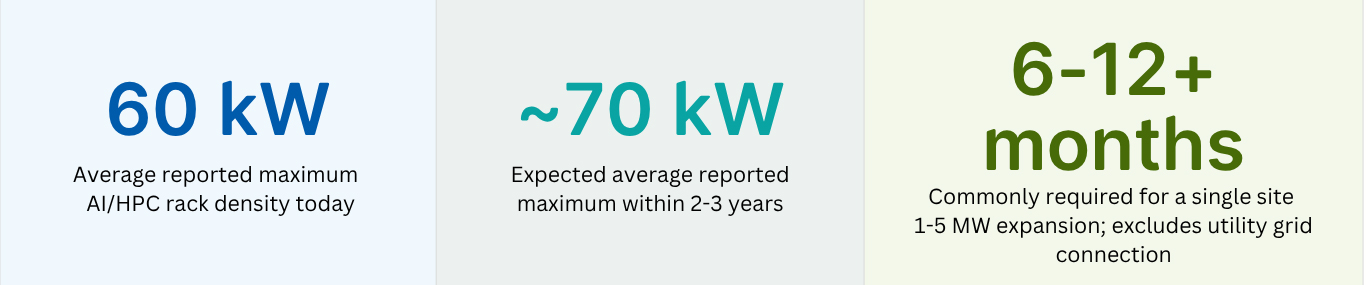
Average rack density has moved from pre-AI norms of roughly 12-15 kW toward a dominant 50-79 kW operating range. Surveyed operators indicate an average maximum AI/HPC rack density of around 60 kW today, expected to approach 70 kW within the next two to three years.
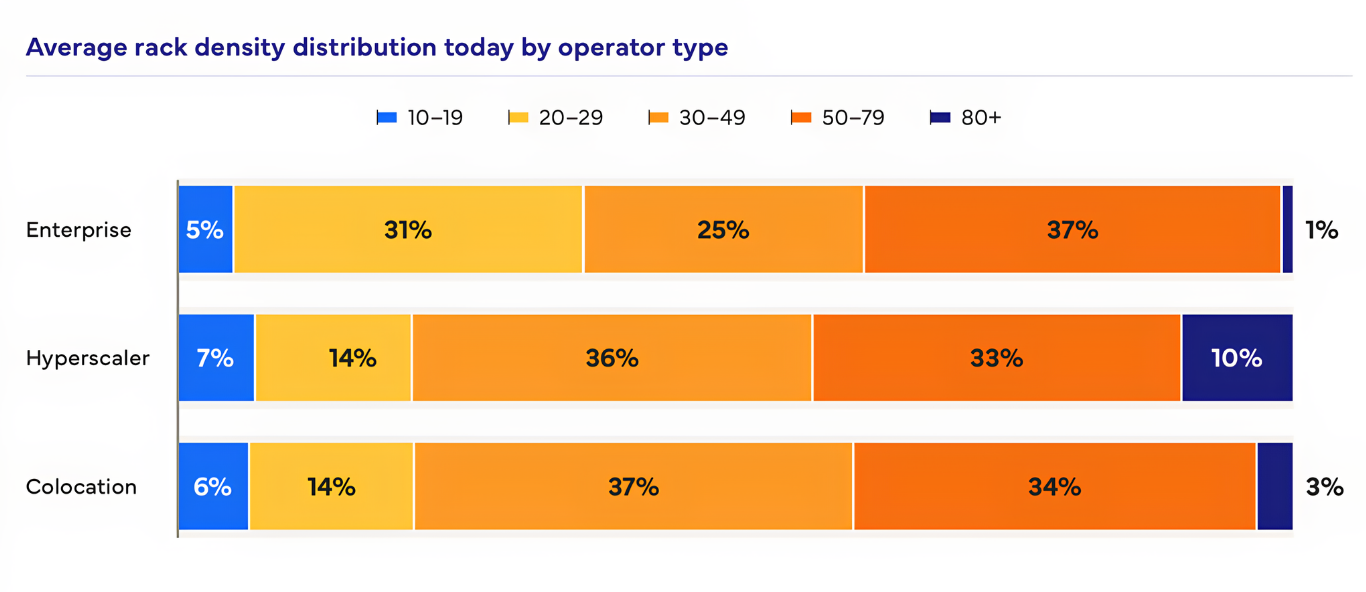
That shift changes more than cooling. Power conversion, distribution, rack delivery, liquid cooling, heat removal, and capacity headroom must be modeled as one capacity envelope.
DELTA SOLUTION BRIDGE: Connect power infrastructure, rack power, liquid cooling, and operational visibility through one Grid-to-Chip planning view.
INSIGHT 2 | TIME-TO-POWER
Will Power Be Ready When Your AI Compute Arrives?
Surveyed operators indicate that a single-site expansion of 1-5 MW commonly requires 6-12+ months, excluding utility grid connection. Fewer than 10% of datacenters across all operator types can deliver additional power in under three months. Where a new utility connection is required, IDC notes that it can add 3-5 years in constrained U.S. and European markets.
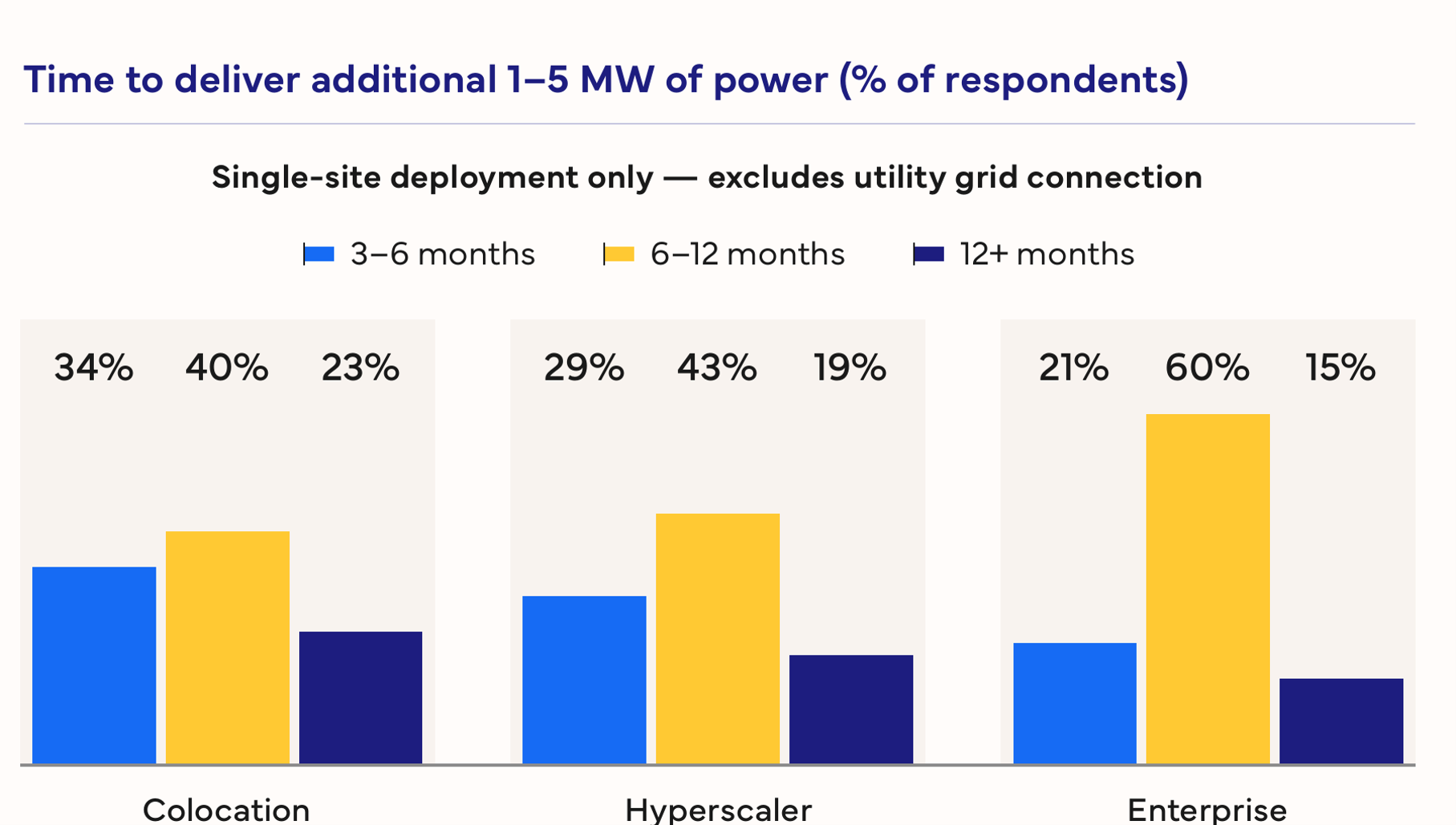
THE BUSINESS RISK _If power availability is validated only after the IT architecture is locked, operators may face redesign, delayed capacity, and longer time-to-revenue.
INSIGHT 3 | SITE SELECTION
Is Power Availability Shaping Your Next Site Decision?
Power conditions are moving to the front of new-site decisions. Among surveyed respondents, renewable energy availability (71%) and grid access or interconnection (57%) ranked far ahead of land availability or cost (3%).
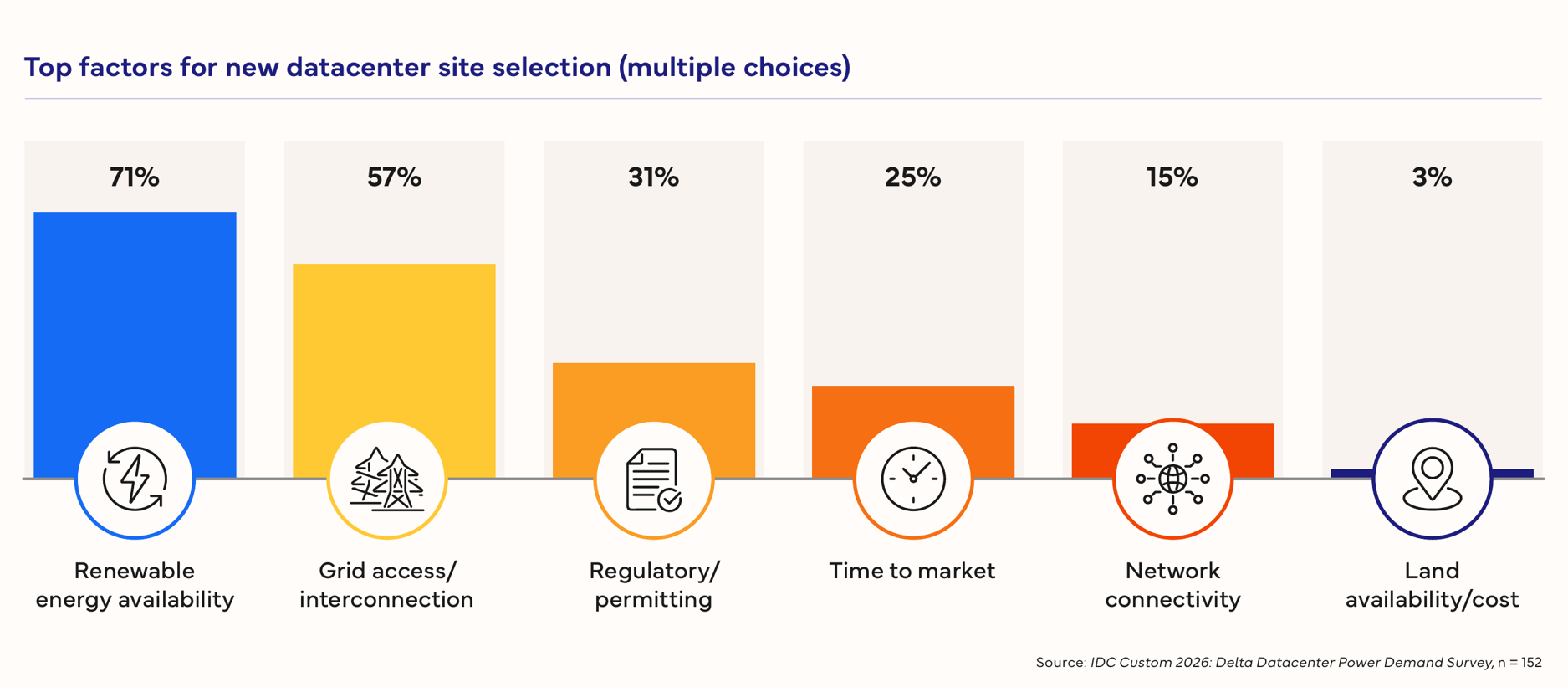
This shifts the site decision from a real-estate-first discussion toward early validation of grid access, renewable supply, power redundancy, and future power-and-cooling pathways.
DELTA SOLUTION BRIDGE: Connect site strategy with power infrastructure, modular deployment, energy management, and Grid-to-Chip readiness before the IT architecture is locked.
INSIGHT 4 | RETROFIT AND SEQUENCING
Are You Removing the Bottleneck - or Just Moving It?
AI scaling barriers are distributed across the full Grid-to-Chip pathway. In the IDC survey, operators pointed to energy cost volatility, permitting and regulatory delays, equipment lead times, cooling capacity, and grid access as interconnected constraints.
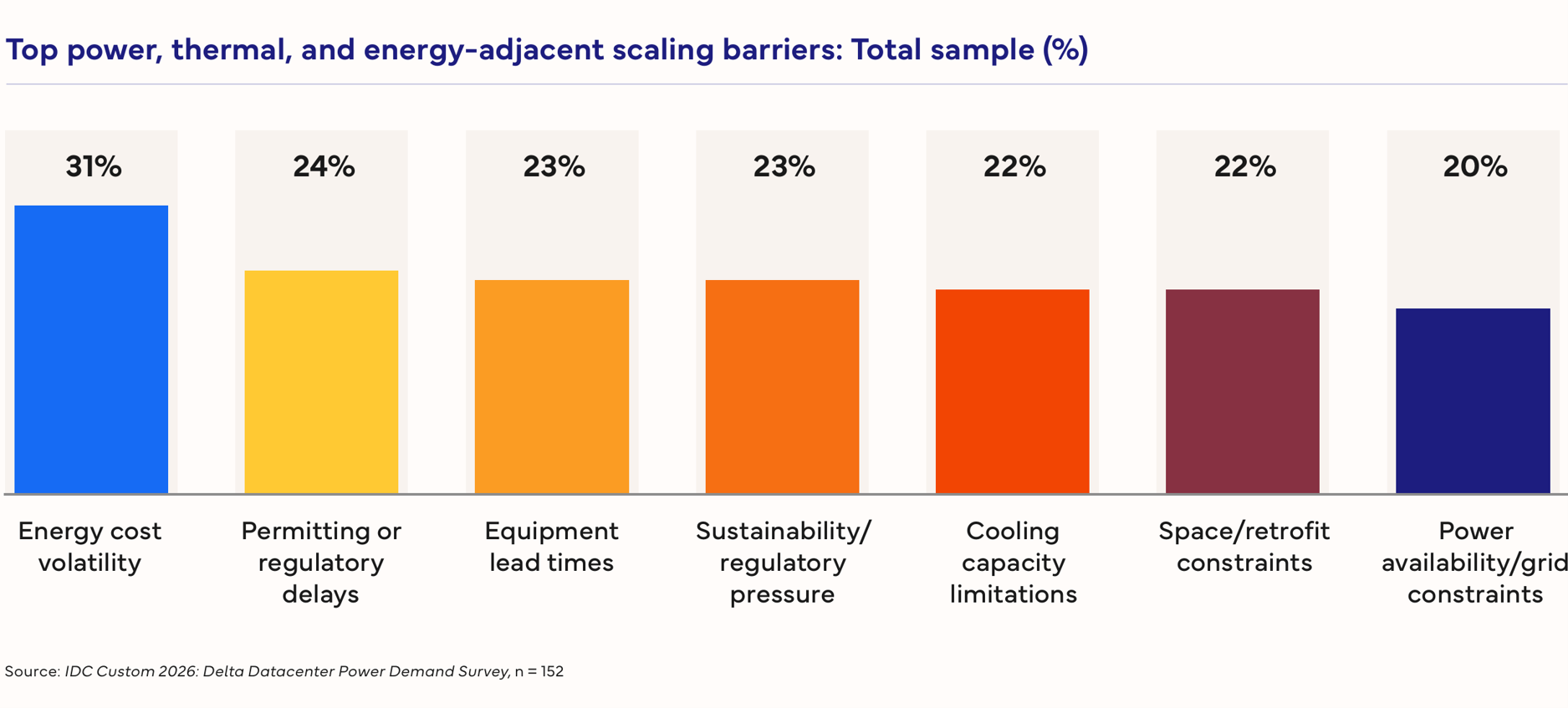
Retrofit priorities reflect the same interdependence: energy management, liquid cooling, UPS/PDU/switchgear, containment, and airflow must be sequenced against the actual limiting constraint.
THE HIDDEN COST OF ISOLATED UPGRADES: Improving one layer without validating the next can create new constraints, repeated construction, avoidable downtime, and capacity that cannot be fully used.
DELTA SOLUTION BRIDGE: Coordinate power, cooling, controls, and operations as one system - then sequence investment around the first limiting bottleneck.
CUSTOMER READINESS ROADMAP
Five Questions to Ask Before Your Next AI Expansion
The immediate action is not to deploy every advanced technology at once. It is to identify which part of the power-and-cooling pathway will constrain the next expansion.
| READINESS ACTION | CUSTOMER QUESTION | |
| 1 | Assess the End-to-End Power Pathway | Where will the next constraint appear - at the grid, distribution, or rack level? |
| 2 | Begin Liquid-Cooling Readiness Planning | What rack density must the facility support over the next two to three years? |
| 3 | Plan for Two Time-to-Power Timelines | Are onsite delivery and utility interconnection aligned with the AI deployment schedule? |
| 4 | Engage Specialist Partners Early | Can power, cooling, controls, and construction decisions be coordinated before procurement is locked? |
| 5 |
Close the Sustainability Measurement Gap |
Can power, cooling, headroom, and resilience be monitored across the full pathway? |
Why Read this InfoBrief?
• Benchmark your AI infrastructure readiness against surveyed peers
• Identify where the next power or cooling bottleneck may emerge
• Understand how rack density is changing facility requirements
• Improve greenfield, retrofit, and capacity-planning decisions
• Build a coordinated power, cooling, and resilience roadmap


